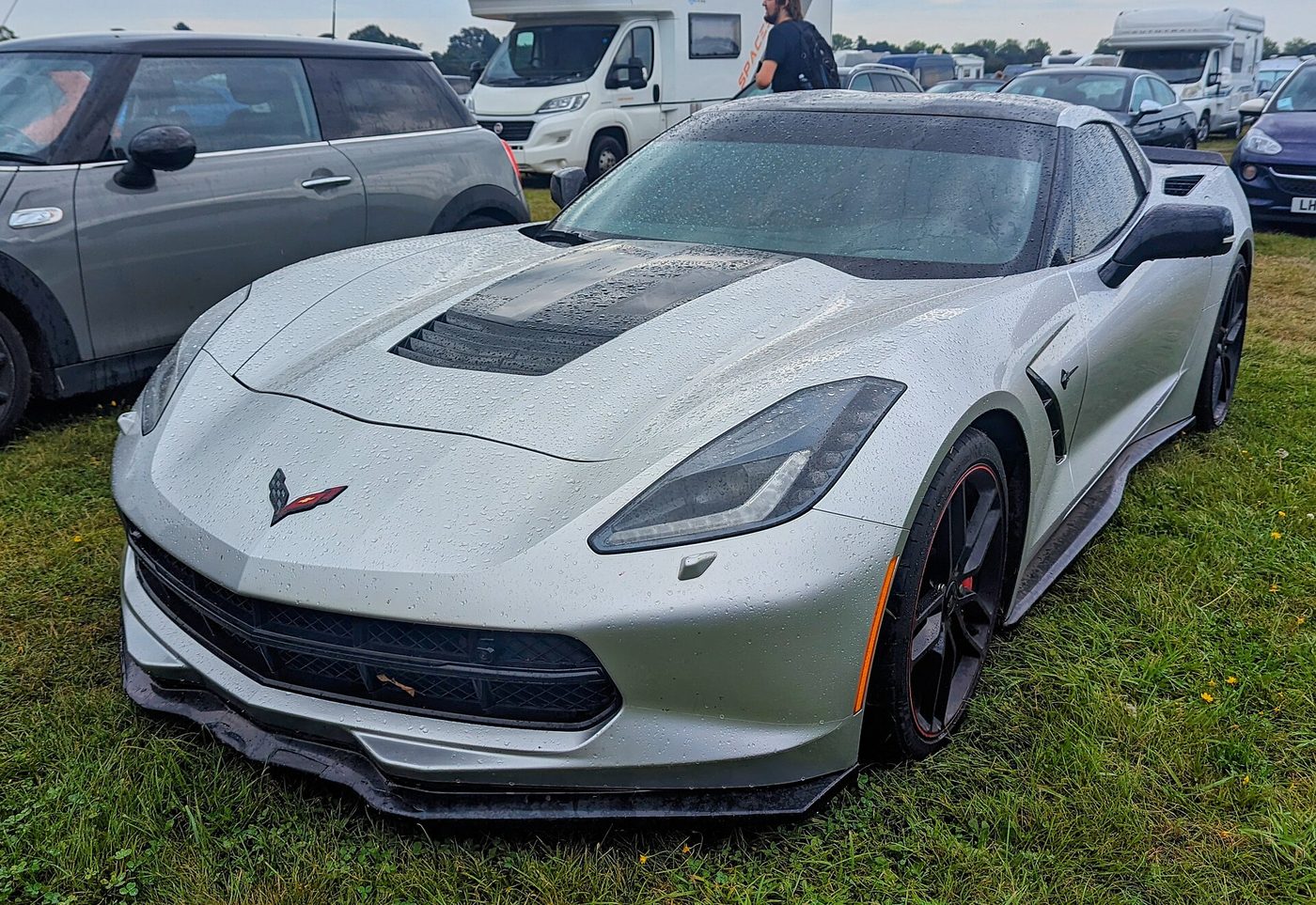
Quick take
The 2017 Corvette is the year the Grand Sport came back, so the used market now has four flavors of C7: Stingray, Stingray with Z51, Grand Sport and Z06. If you want a car that looks and handles like a Z06 without the supercharger, the Grand Sport is the one to look for. If you want the most extreme version, that is the Z06.
Be ready for one big issue. NHTSA lists 257 complaints for this model year, and 224 of them are about wheels. That is by far the largest pile in this five-year series. Check the wheels first. Then confirm the steering recalls on the VIN, because loss of power steering assist is the second biggest complaint group, and make sure any airbag software recall was completed.
What changed for 2017
By 2017 the C7 was in its fourth year, and the car was a known quantity. The big news was the return of the Grand Sport, which sat between the Stingray and the Z06 in the lineup. It was sold as a coupe and as a convertible. Complaints in the data refer to a Grand Sport with chrome wheels, a reminder that wheel finish and design vary by car and by option package.
The Stingray with its Z51 package and the Z06 continued. As in earlier years, automatics used an eight-speed and manuals used a seven-speed.
Ask the seller for the window sticker or a build sheet. On a Corvette, the option list tells you more than the model year does. It shows whether the car has the performance package, which wheels it came with, and whether it was ordered as a convertible. The facts that matter for your shopping are which version it is, how it was driven, and what has been changed since.
Known trouble spots to check
NHTSA lists 257 complaints for 2017. Wheels account for 224, steering for 19, and the electrical system, fuel system and others for just a handful each. The wheel number is so high that it should shape your whole inspection. Remember that complaint counts do not prove how many cars are affected, and that wheel complaints can come from hard-driven cars as well as gentle ones.
Wheels. Owners describe slow leaks, a tire pressure warning light, and cracks on the inside of rear wheels, often found at a tire shop or dealer. Some say they replaced or repaired many wheels, and a few say the same wheel cracked repeatedly. One owner of a Grand Sport describes cracked chrome wheels at about 30,000 miles. Others say the car vibrated before they found the crack. Take the wheels off if the seller allows it, or inspect the inner barrels with a light and a mirror. Ask for every receipt for wheel repair or replacement, and ask whether the wheels are original. A welded wheel is a repair, not a fix for a defect in the design, and you should consider what happens if it cracks again.
Steering. Owners describe a sudden loss of power steering assist, a warning on the dash and a very heavy wheel until the car is restarted. Some describe it at low speed in parking lots, others at highway speed. One owner says a dealer told them their car was not included in the recall. Another describes a loss of steering assist along with brake assist, ABS and traction control lights, with several warnings on the dash at once. On the test drive, watch the dash for warnings, and turn the wheel lock to lock when parked. Ask the seller if it has ever failed.
Electrical and infotainment. Owners describe a center screen that went blank, taking audio and the backup camera with it, and a climate control quirk tied to the convertible top switch. Others mention a navigation system that did not recognize a road. Spend a few minutes with the screen, the camera, the climate controls and the top if the car is a convertible.
Fuel system. A few complaints describe fuel odor, a leak at the primary fuel pump module flange, and a filler neck leak. Smell the car, and look for wet spots beneath it. One complaint also raises a concern about plastic parts in the exhaust valve actuators. That is one owner's opinion, but it is a reason to ask about the exhaust and whether it is stock.
General checks:
- Dashboard covering. One owner describes leather lifting from the dash. Run a hand along the dash top.
- Brake feel. Listen for rotor noise and feel the pedal on a firm stop.
- Tires. Look at date codes and wear on all four.
Recalls on a car this age
Four recalls appear for 2017. Two involve steering and two involve airbag software.
- Electric power steering assist. Two recalls, one issued in 2019 and one in 2025, say the electric power steering assist may fail. Both cover certain vehicles, and both include Corvette along with certain Cadillac and Camaro models. The recall text lists "certain" Corvettes, so not every car is covered. Some owners say their dealer told them their VIN was not in the recall, so a VIN lookup is the only way to know.
- Airbag software. One recall covers certain 2014 to 2017 Corvettes and many other GM models. The airbag sensing module software could start a diagnostic test under certain driving conditions, and during that test the frontal airbags and seat belt pretensioners would not deploy in a crash. A second recall says some cars repaired under the first one may not have received the complete update.
Recall repairs are free at any Chevrolet dealer. Check the VIN at NHTSA's free recall lookup before you buy.
Test-drive checklist
- Look at all four wheels closely before you start. Check the inside of the rear wheels with a light, and look for welds or repair marks.
- Start the car cold and watch the dash for any warnings. Check that the steering wheel turns freely with the engine on and off.
- Drive a bumpy stretch and listen for clunks and vibration. Then drive at highway speed and feel for any vibration through the wheel or seat.
- Roll on the throttle lightly in an automatic. Feel for shudder, hesitation or a harsh shift. In a manual, check clutch slip under load and shift effort.
- Brake hard from a high speed. The pedal should stay firm, and the car should stop straight. Check rotor condition afterward.
- Test the steering at low speed in a car park and at highway speed. It should be consistent, with no sudden heaviness or warning messages.
- Run the infotainment, camera, climate and convertible top (if it has one) through their paces.
- After a long drive, check the temperature gauge, look for fluid leaks and smell the rear of the car for fuel.
Before you hand over money
Do three things before buying:
- VIN recall check at the NHTSA link above. Look closely at the steering recalls.
- Vehicle history report, to look for accidents, title issues and odometer problems.
- Pre-purchase inspection by an independent shop that knows C7 Corvettes, with an inspection of the wheels, a scan for stored codes and a look at the underbody.
For a modified or tracked car, ask what was installed, who installed it, and whether the engine or transmission was tuned. Ask for the tune file, receipts for brakes, tires and fluids, and the track history. Ask whether the original wheels, exhaust and suspension parts are still around.
Use the payment calculator to see a monthly figure with tax, fees and interest.
Is it the right car for you?
The 2017 Corvette suits a buyer who wants a Z06-like look and feel with the Grand Sport, or who wants the Z06 and is willing to be picky about wheel history. It also suits a buyer who values modern controls and a comfortable cabin. Compare it with the 2016 and 2018 reports, or read the overview.
Look elsewhere if you cannot accept a risk of cracked wheels, or if you do not want to chase a recall by VIN. A car with an unknown history and no inspection is not a good bet in this model year.
Bottom line
The 2017 Corvette is a strong performance car with a loud complaint record about wheels and a recall record about steering and airbag software. Inspect the wheels, confirm the recalls, and treat the seller's history as part of the price.